
I was nervous walking to the address in Kakinokizaka. Experiencing a formal tea ceremony in Japan had been on my wish list for years, and now that the moment had finally arrived, I wasn’t entirely sure what to expect.
Known as chanoyu (or sado/chado), I had only an abstract idea of what a Japanese tea ceremony was like. I knew it was formal, structured, and rooted in tradition, with a very specific way of doing things.
In Japan, there’s an unspoken expectation to follow rules carefully. I try to be mindful of these rules, but even unintentional missteps can be met with frowns and disapproval. As someone who tends to overthink, I worried about making a mistake and embarrassing myself, especially in a setting as structured as a formal tea ceremony.
Walking up to the house, it was too late to back out now. This was my opportunity to learn, and I wasn’t about to let my anxiety get the better of me.
I took a deep breath, rang the doorbell, and waited to be let in.
TEA CEREMONIES IN TOKYO
A curated list of tea ceremonies in Tokyo to make your trip truly special.
- Authentic Japanese Tea Ceremony in a Private Tea Room
- Tea Ceremony and Kaiseki Lunch at a Historic Restaurant
- Private Evening Cha-Kaiseki Dinner and Personalized Cocktails in a Special Tokyo Tea Room
- Bonsai Creation and Tea Ceremony at Master Kunio Kobayashi’s Shunkaen Bonsai Museum
- Learn Traditional Confectionery from a Professor of the Bifu Style Sencha Tea Ceremony
WHAT IS THE PURPOSE OF A TEA CEREMONY IN JAPAN?
For Westerners, the consumption of tea is mostly a social experience. British high tea, for example, is about gathering and indulgence – enjoying cups of tea in a relaxed setting over food and conversation. A tea ceremony in Japan is quite different from that. Its purpose goes far beyond the mere consumption and enjoyment of tea.
At its core, a Japanese tea ceremony is about cultivating presence. Deeply influenced by Zen Buddhism, it’s an intentional slowing down that invites both host and guest to step outside the rush of everyday life and fully inhabit a single, shared moment.
Every movement in the ceremony is deliberate – from the way the tea is whisked to how the bowl is turned before drinking. These gestures aren’t meant to impress, but to focus attention.
In a world that constantly pulls us in multiple directions, the tea ceremony creates a rare space where nothing is rushed, wasted, or taken for granted. Time slows, and the act of making tea becomes a form of quiet meditation.
There is also a deep emphasis on hospitality and connection. The host prepares the tea with careful consideration for the guest – choosing utensils, arranging the space, and timing each step with intention. In return, the guest receives the tea with gratitude and respect. It’s a subtle but powerful exchange, one that reflects the idea that even the simplest interactions can carry meaning when approached with mindfulness and care.
Underlying it all is the concept of ichigo ichie. An appreciation for impermanence, it’s the understanding that no two tea ceremonies are ever the same. The season, the setting, and the people involved all shape the experience. This fleeting quality is part of what makes it meaningful. The ceremony encourages you to recognize that this particular moment, shared in this particular way, will never happen again.
In that sense, the purpose of the tea ceremony isn’t just about tea. It’s about learning how to be present, how to notice, and how to find depth in the ordinary.
A MORNING OF STILLNESS: EXPERIENCING A TEA CEREMONY IN TOKYO
Wabunka offers several tea ceremony experiences in Tokyo. I experienced this tea ceremony at To-Ri-An, an Urasenke school located in a residential part of Tokyo’s Meguro Ward. The Urasenke school is the largest of three main tea ceremony schools in Japan.
To-Ri-An is run by a husband-and-wife team – Souei Funakoshi and Souai Kawada. Both are associate professors of the Urasenke school. I had expected an interpreter to join the ceremony, but both professors turned out to be fluent in English.
Met by Souei-san at the door, I removed my shoes and was taken to this tea room, where Souai-san sat me down in front of the tokonoma (alcove).
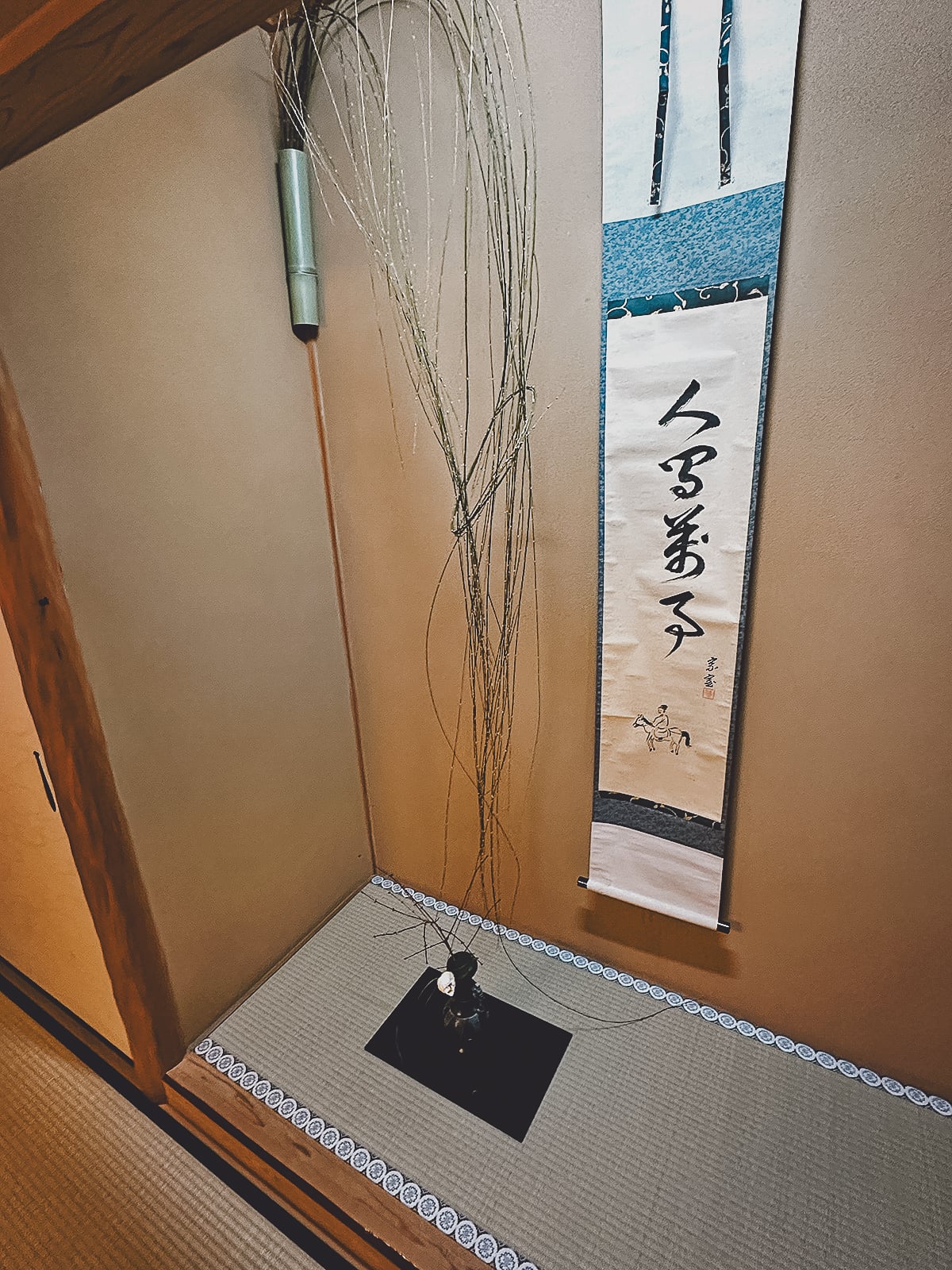
Souai-san explained that the tokonoma – where the kakemono (hanging scroll) and chabana (simple flower arrangement) are displayed – is the spiritual heart of the room. It’s the first thing guests are meant to observe when they enter the tea room.
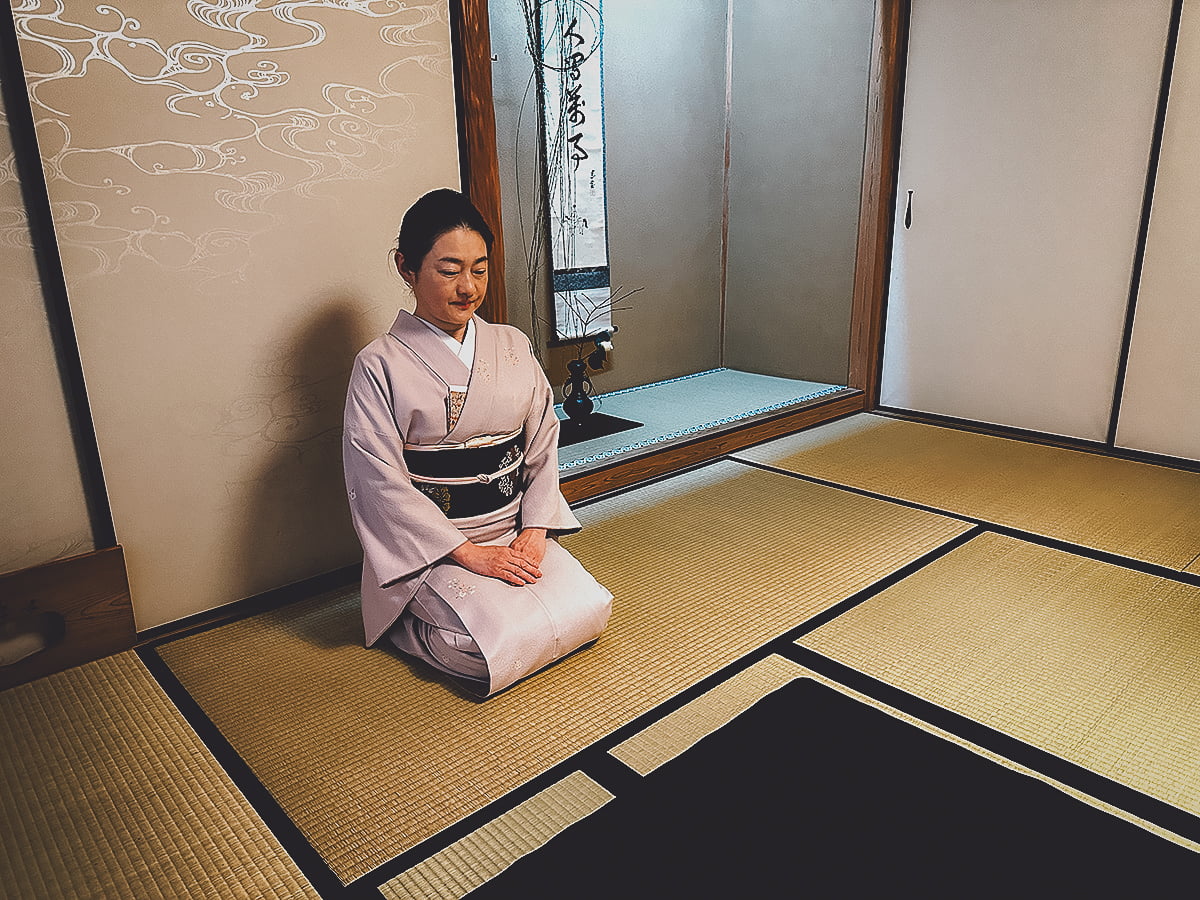
Like in many aspects of Japanese culture, seasonality plays an important role in chanoyu. The hanging scroll features calligraphy chosen specifically for the occasion. It’s often reflective of the season and conveys a philosophical idea or mood that the host wants to convey.
During my tea ceremony, the chosen scroll recounted the popular Daoist parable known as the “Story of the Lost Horse”. It’s a powerful parable that reminds us to accept the world as it is, and not how we want it to be.
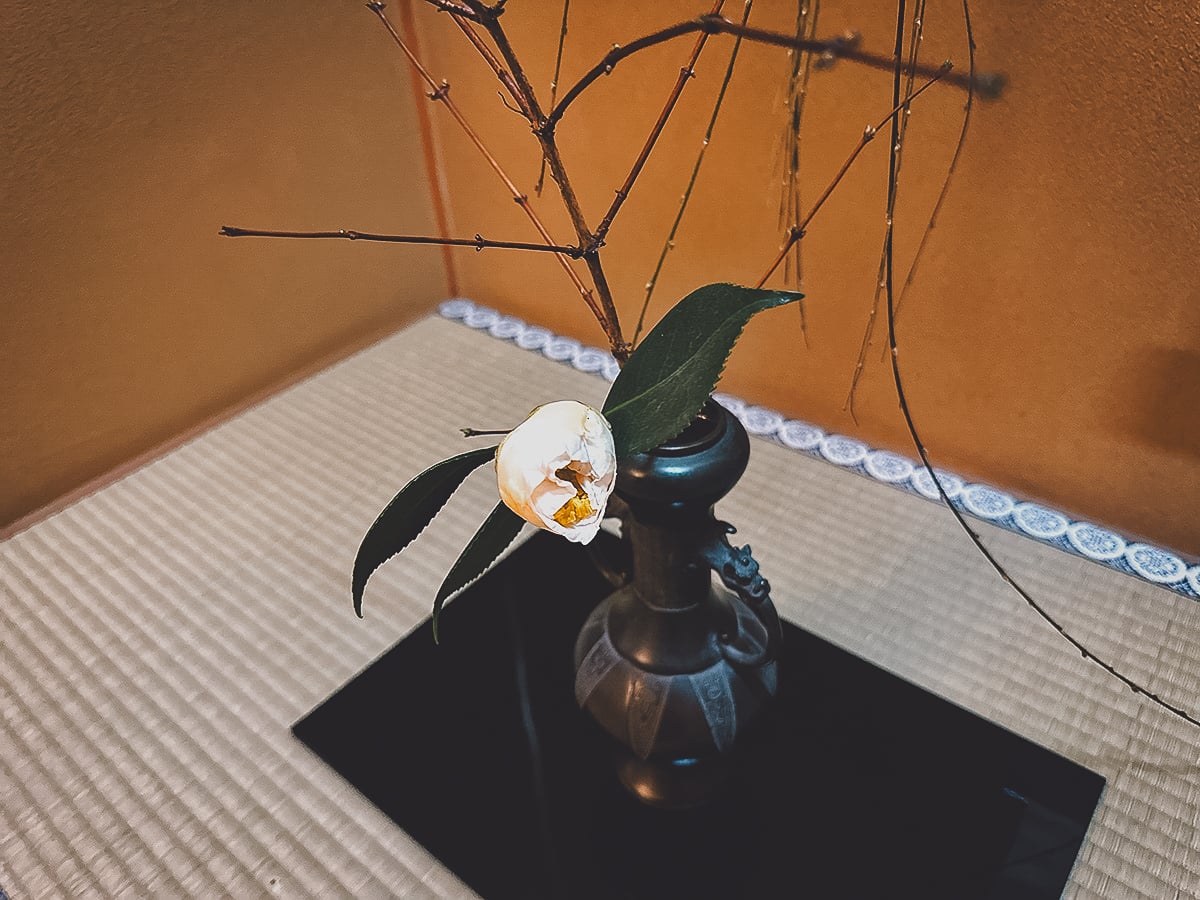
I visited To-Ri-An in late winter, hence the use of the tsubaki flower (camelia) in today’s flower arrangement. It blooms from late winter to early spring, making it one of the most commonly used flowers in chanoyu during the colder months.
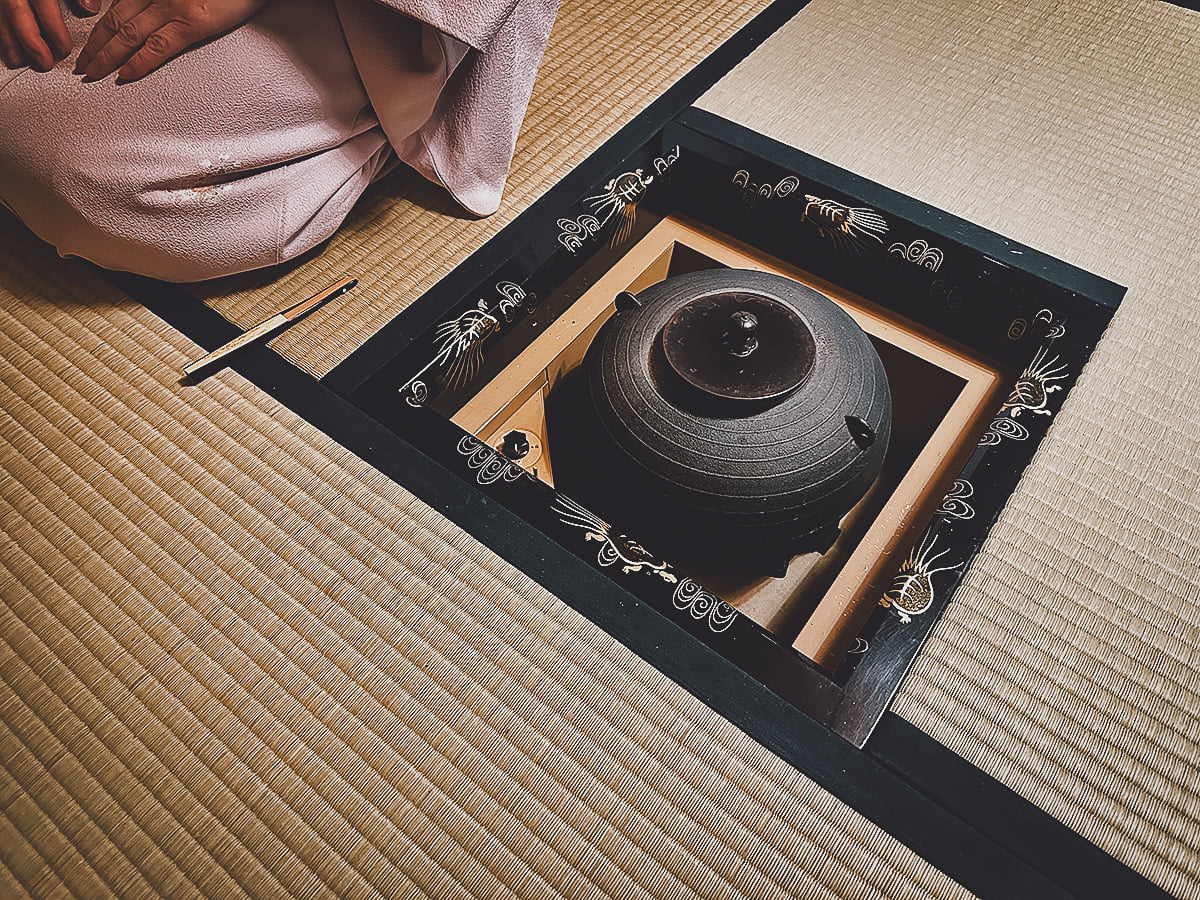
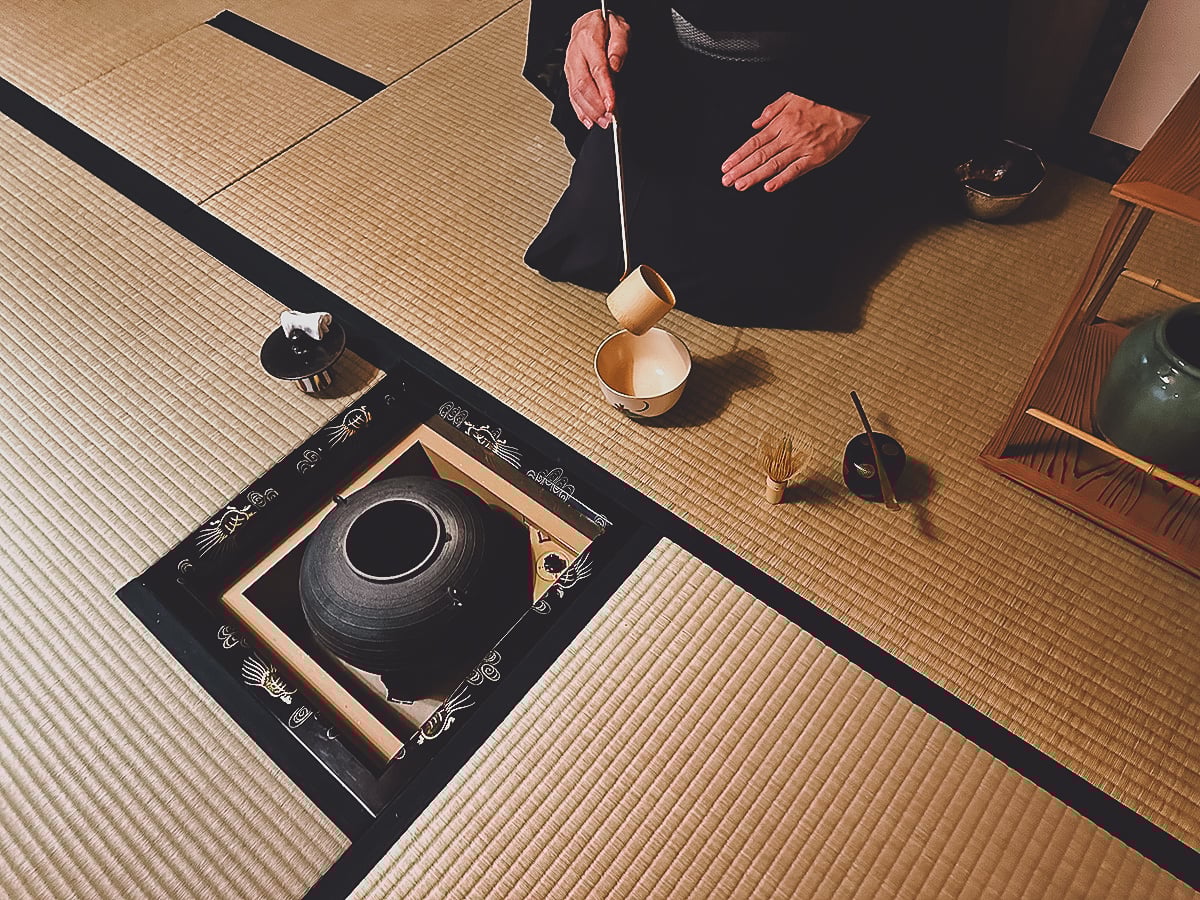
Facing the alcove sits this sunken hearth with a kama kettle used to heat water for tea. A sunken hearth is typically used in winter, but in warmer months, a portable brazier is preferred.
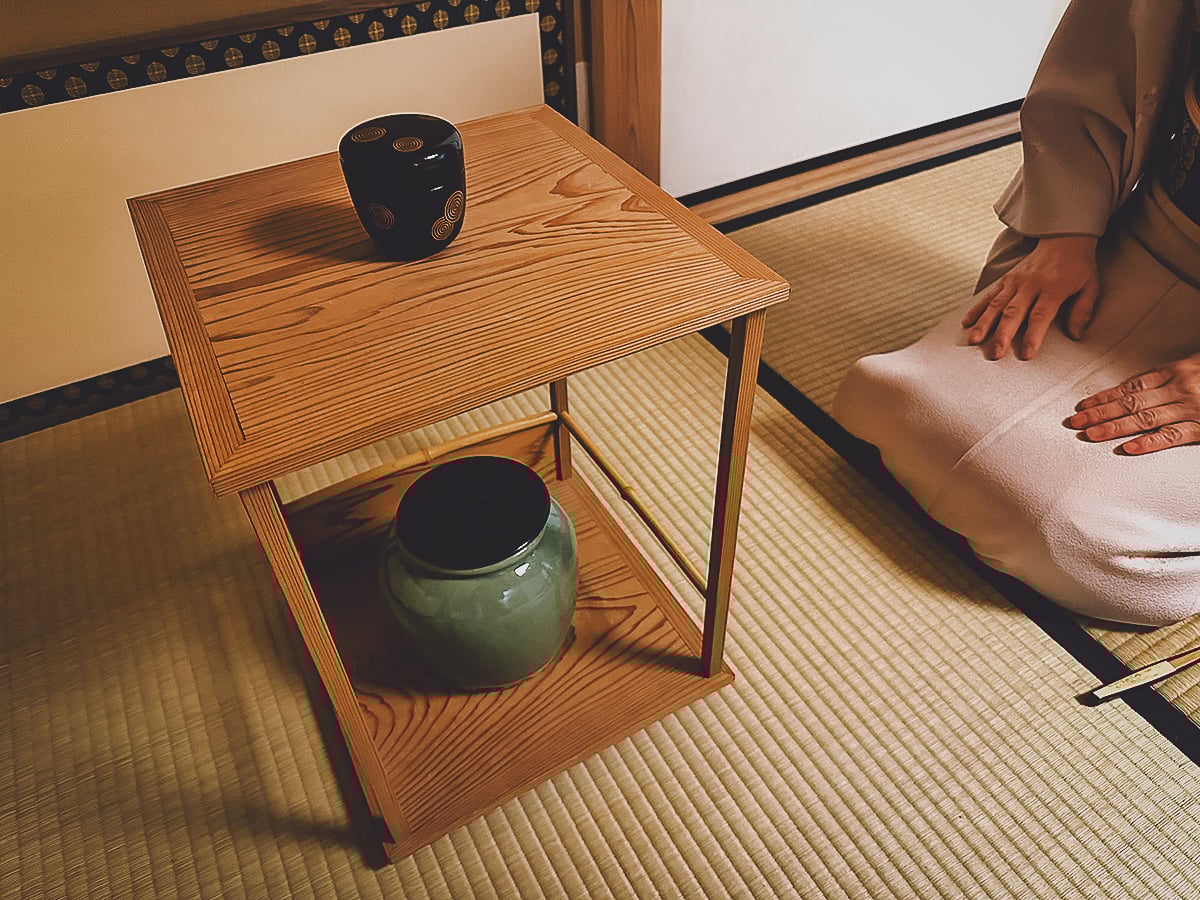
Souai-san directs my attention to the tana, a small stand used for utensils. Sitting on top is a small tea canister, while on the bottom is the mizusashi – a larger vessel containing fresh, cold water to replenish the kama and to rinse and purify utensils used in the ceremony.
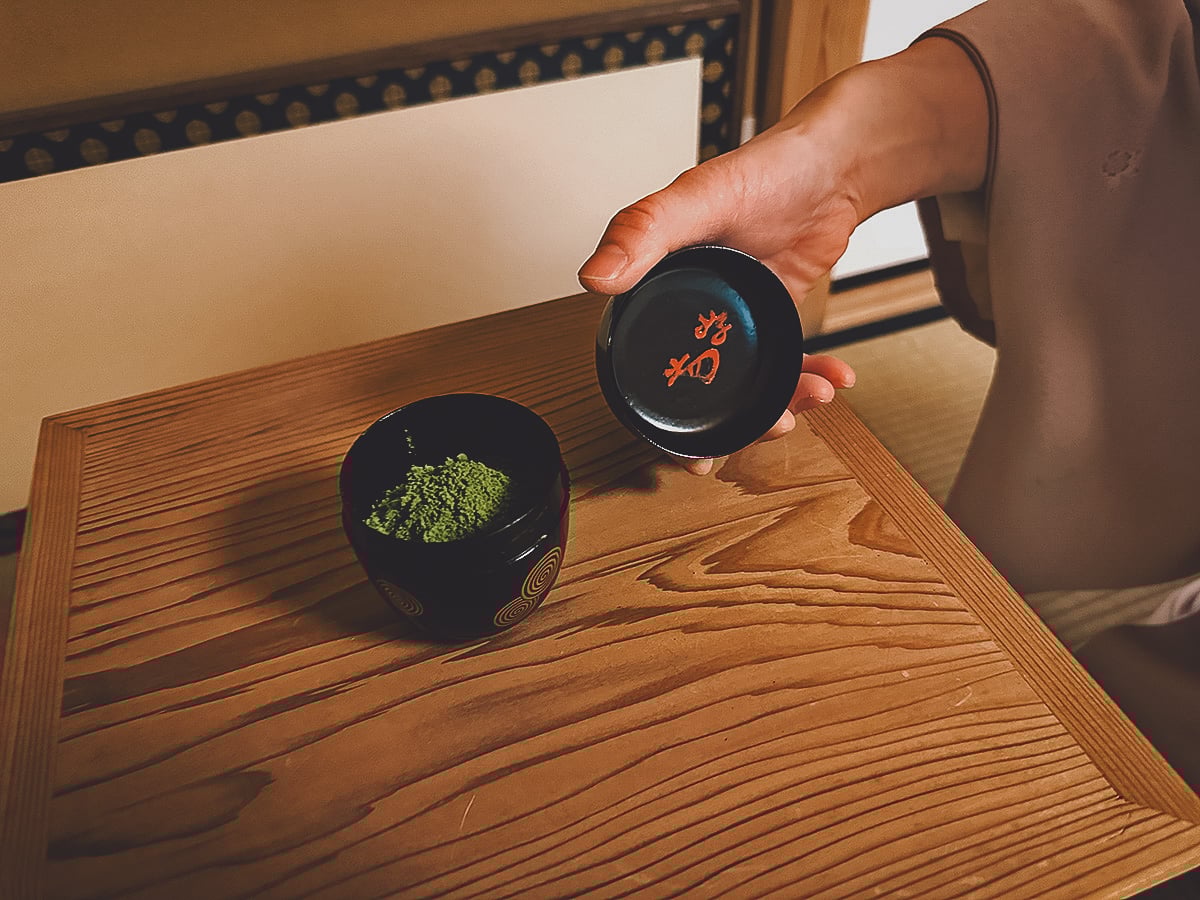
Souai-san then opened the canister to show me this calligraphic inscription under its lid. It bears the name of the tea master to certify the quality of the matcha.
Souai-san directed me to my seat and explained proper etiquette and the correct way to sit. The traditional Japanese sitting position is called seiza – sitting on your heels with your legs folded beneath you.
If you aren’t used to sitting like this, then it can be difficult and a little painful to maintain. I wanted to impress my hosts, so I did my best to bear the discomfort, but I’ve read that the Urasenke school allows guests to sit on stools. It’s one of the subtle variations that differentiate Urasenke from Omotesanke and Mushanokoujisenke.
Once I was in position, the sliding door opened, and in walked Souei-san with a plate of wagashi – a traditional Japanese confection served with green tea. Opening bows were exchanged, and the tea ceremony officially began.
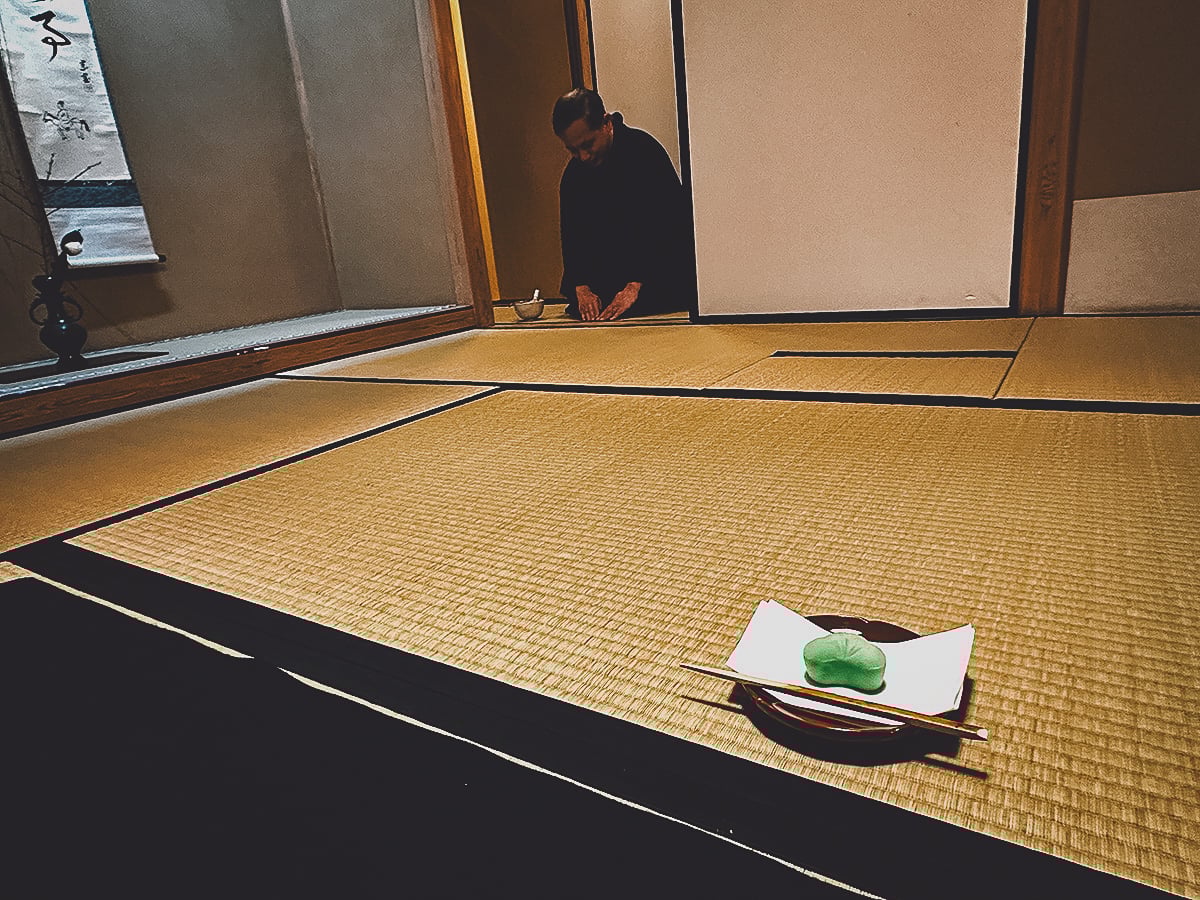
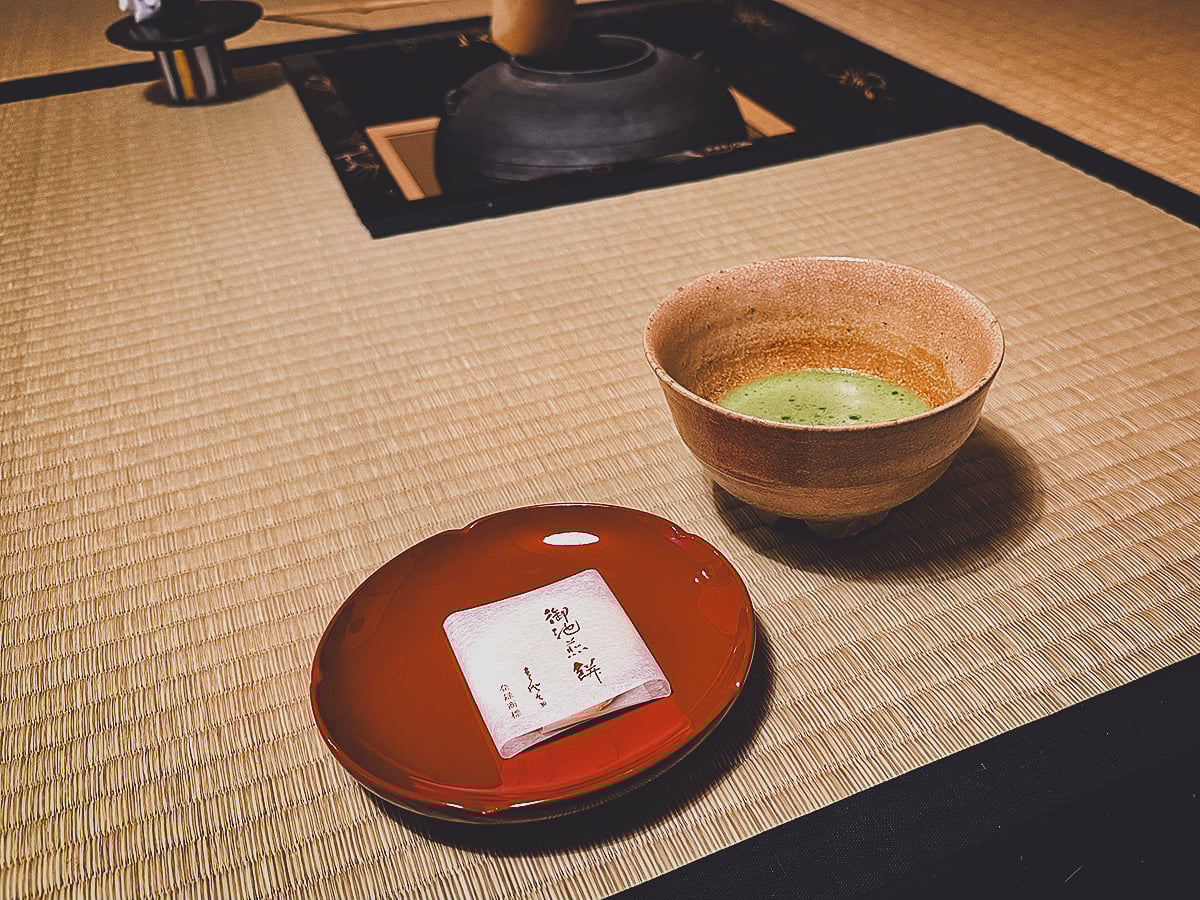
I’ve enjoyed matcha and wagashi many times at Japanese gardens, but no one ever told me that you’re supposed to eat the wagashi first before drinking the tea. Grassy and intense in flavor, the taste of matcha can be jarring for some people, so the wagashi is meant to line your mouth with sweetness to help soften the bitterness of the tea.
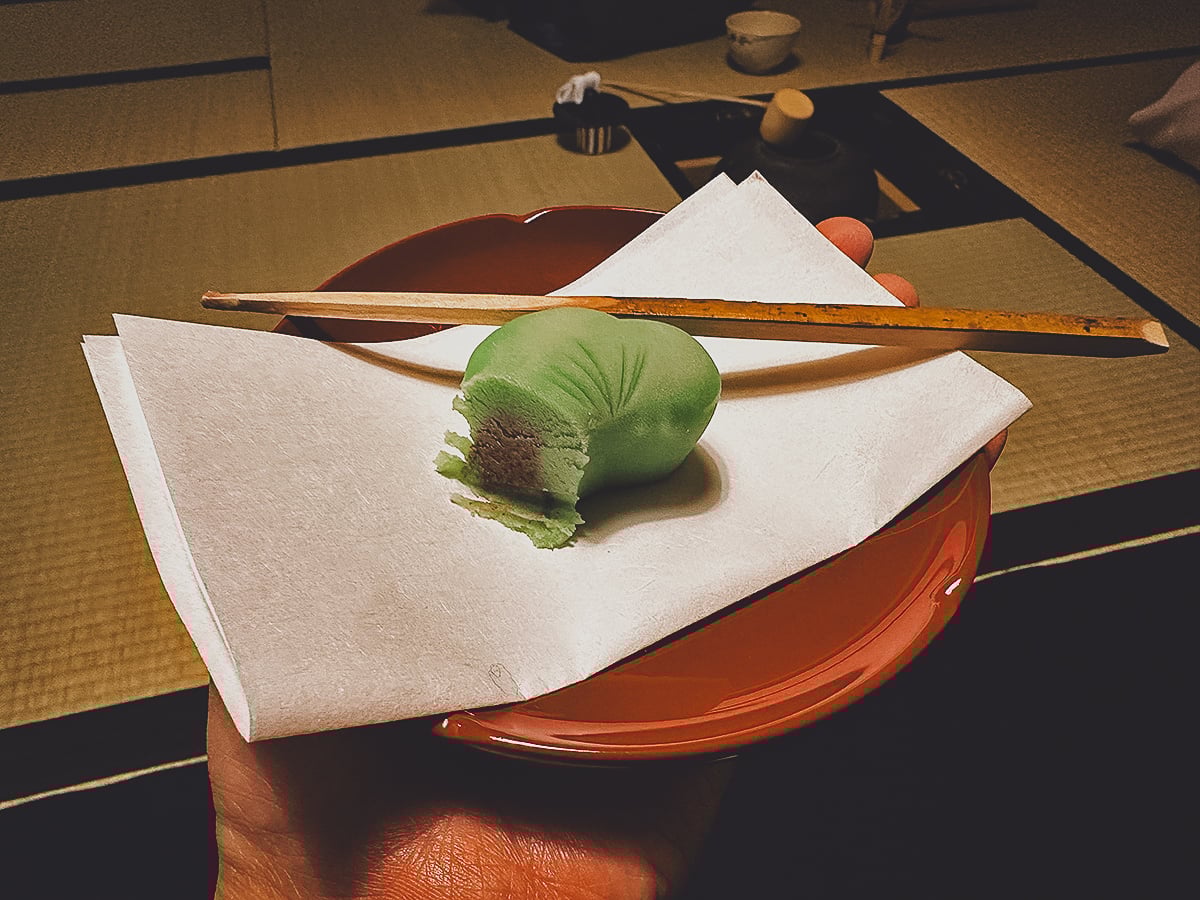
Wagashi comes in many different varieties, among the most beautiful being nerikiri – a type of seasonal handmade wagashi made from white bean paste. This one was filled with a sweet bean paste and made to resemble a leaf, perhaps to signify the coming of spring.
From the moment Souei-san walks into the room, you’ll notice how rigid chanoyu is compared to Western tea culture. To start, there’s hardly any conversation. Long stretches pass in silence, and whatever’s uttered is part of the ritual. This is intentional.
Without conversation to distract you, your attention shifts elsewhere – to the way Souei-san purifies the utensils, to the sound of water heating in the kettle, to the precise choreography unfolding before you. In the Japanese tea ceremony, every action is precise, and nothing is improvised – not even the way Souei-san folds the cloth or the angle by which he holds the ladle.
This meticulous precision – combined with mastery of ritual and mindful presence – is why it takes years, even decades, to become a master of the tea ceremony.
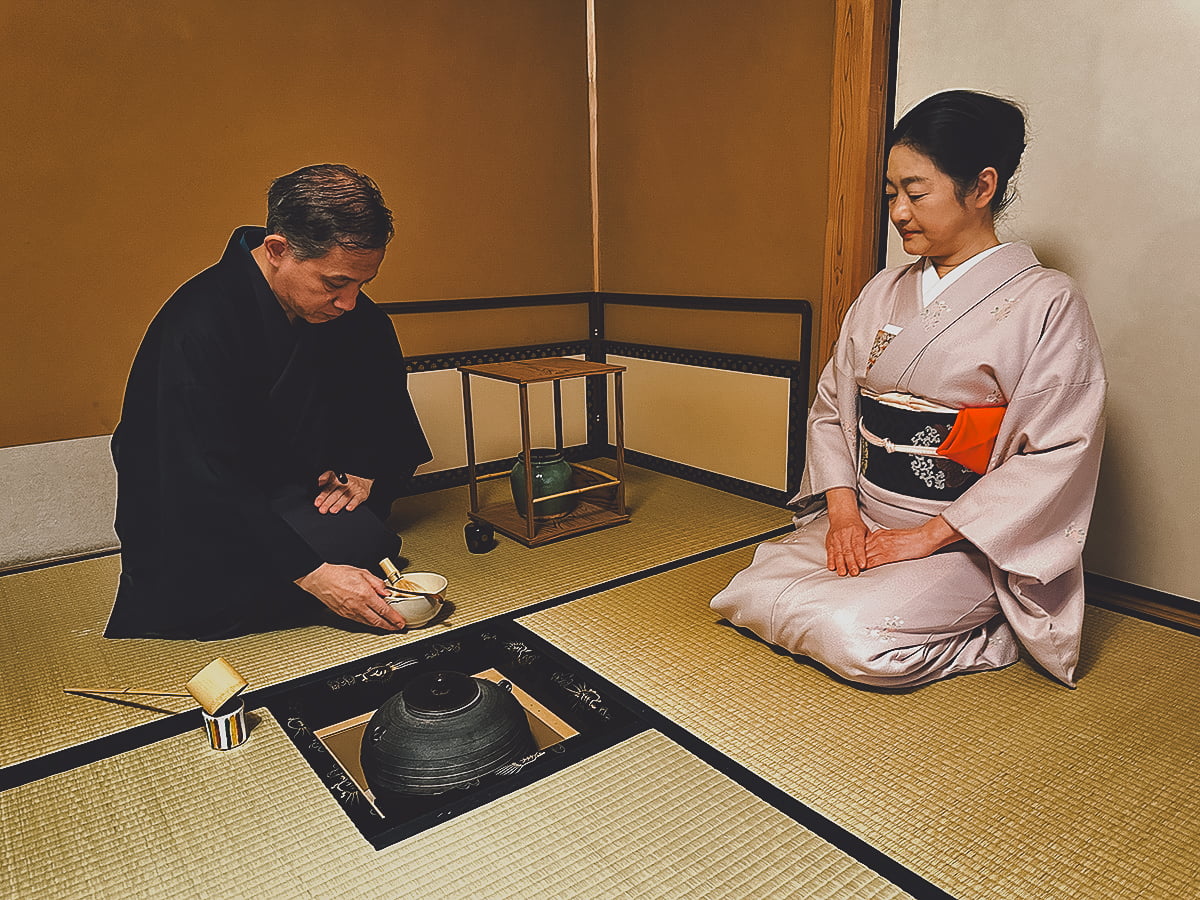
As beautiful as the Japanese tea ceremony is in principle, many foreigners may find it too formal and restrictive, and that’s fair. But it’s important to understand that the formality of chanoyu has its purpose.
The rigidity is meant to remove distraction and narrow your focus to the choreography of the experience. Drawing from Zen Buddhism, it’s meant to bring you into the present moment, into the now. It’s less about perfection and more about presence.
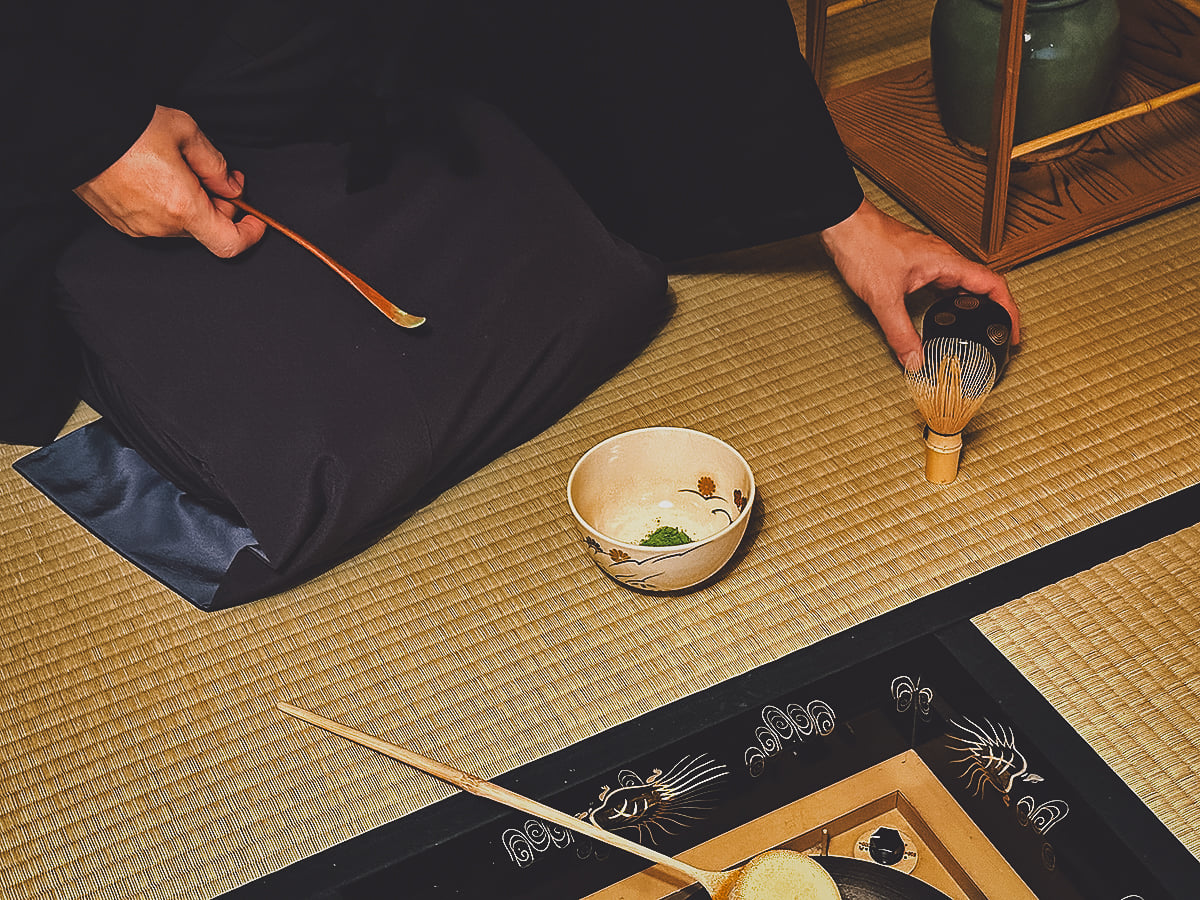
Aside from Souai-san explaining chanoyu etiquette to me, very little conversation passed between us. From the purification of the utensils to the whisking of the matcha, our attention was fully fixed on master Souei-san’s preparation of the tea.
As a guest experiencing a Japanese tea ceremony for the first time, I couldn’t help but be drawn into its quiet discipline.
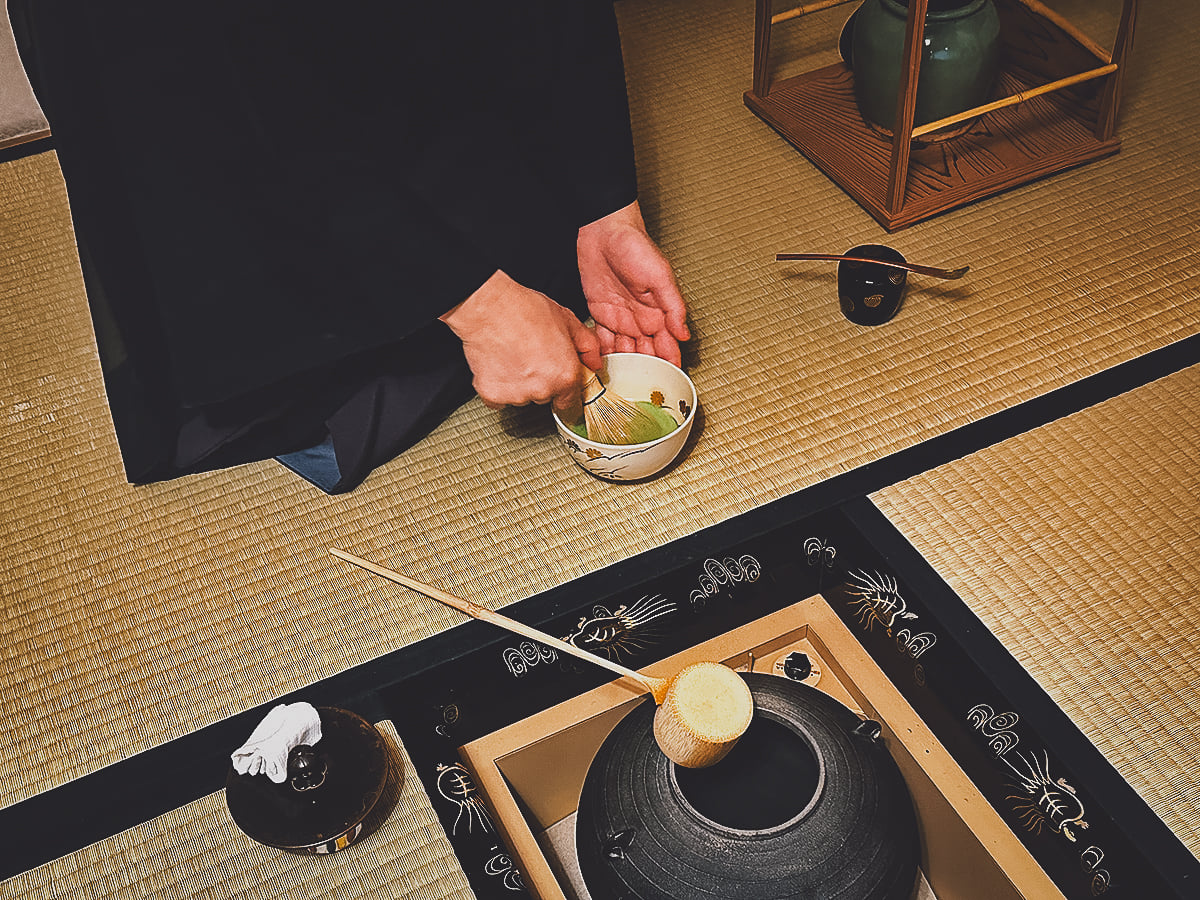
From start to finish, there’s a fixed progression to chanoyu. The formality doesn’t ease after the matcha has been served to you. There’s a way to bow, a way to receive the tea, even a way to drink it.
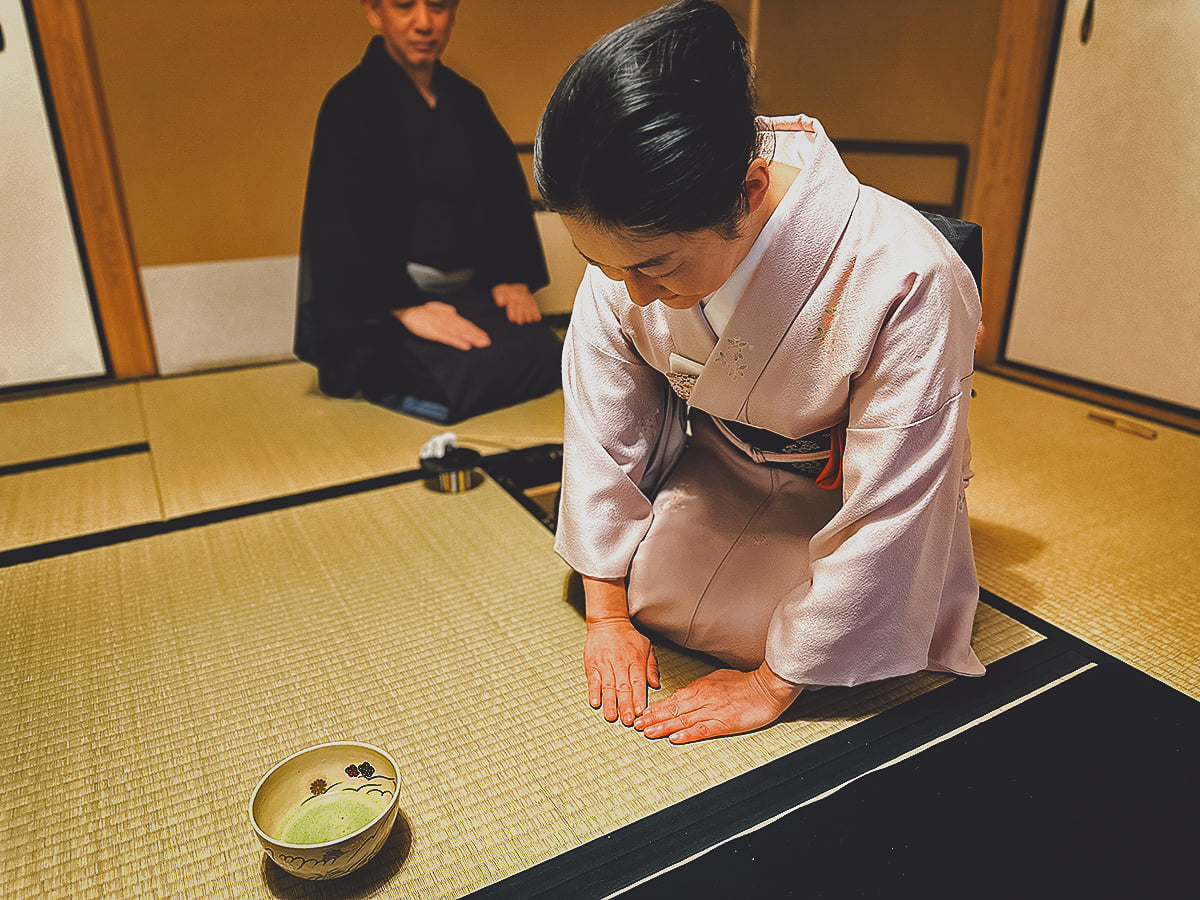
Served with another sweet – this time a type of higashi (dry wagashi) – Souai-san instructed me to bow before picking up the bowl and placing it in the palm of my left hand. She instructed me to turn the bowl twice using my right hand before drinking it.
Like ramen, you’re expected to make a slurping sound when you drink your tea. Rather than lingering over it like a latte at Starbucks, it’s meant to be consumed in four or five steady sips, done continuously with a consistent rhythm between sips. As I said, the formality of a Japanese tea ceremony is maintained from start to finish.
After taking my last sip and thanking him for the tea, Souei-san begins the meticulous process of cleaning and wiping down the utensils. As in its preparation, the same measured care is shown. Even in conclusion, the ritual holds its form.
Quietly watching him do this, I can’t help but think that there’s a certain symmetry to it all. The same attention that guided the whisking of the tea now governs the wiping of the bowl. Conversation remains minimal as I continue to hold the seiza position, my legs and ankles screaming for relief.
In these final moments, it becomes clear to me that this ceremony was never about drinking tea. Inviting presence, it was about being part of a sequence of moments where every action – no matter how insignificant – carried intention.
FINAL THOUGHTS ON THE JAPANESE TEA CEREMONY
A Japanese tea ceremony is every bit as formal and structured as I expected. It asks for your full attention and a certain level of restraint, something that, as a first-time participant, didn’t always come naturally. I found my mind drifting at times – perhaps because I was trying to document the experience instead of simply being in it.
If you do decide to experience a tea ceremony in Japan, I suggest putting the phone or camera down. With fewer distractions, it becomes much easier to settle into the rhythm of the ceremony and appreciate what’s happening in front of you. Being present, more than anything, is the point of chanoyu.
As previously described, a Japanese tea ceremony isn’t like British high tea. It isn’t a casual, social affair. It’s quieter, more deliberate, and in many ways, more demanding. But that’s exactly what makes it meaningful.
Chanoyu offers a deeper way of experiencing Japan – one that isn’t about sightseeing or taking selfies in front of landmarks. If you’re interested in understanding Japan beyond the surface, then it’s an experience well worth having.
I experienced this chanoyu at To-Ri-An, but there are several tea ceremony experiences you can book on Wabunka.
Disclosure
This article on tea ceremonies in Tokyo was written in partnership with Wabunka. As always, all words, thoughts, and opinions expressed in this article are mine and mine alone.
Some of the links in this article are affiliate links, meaning we’ll earn a small commission if you make a booking at no additional cost to you. We really appreciate your support, as it helps us make more of these free travel and food guides. Arigato gozaimasu!