
It was our first trip to Rome, and there were three touristy things at the top of my to-do list.
One, visit the Colosseum and shout shyly whisper “Are you not entertained?!” Two, throw a coin into Trevi Fountain. And three, take a pasta-making class.
The first two were taken care of on our first two days in Rome. The third, and perhaps the one we were most excited about, we saved for our last day, to punctuate an incredible two months of eating the most delicious food throughout Italy and Europe. To top it all off, the class was held in Trastevere, one of the coolest and most atmospheric neighborhoods in Rome.
If you’re looking for a fun cooking class to make your trip to Rome even more memorable, then this pasta-making class with Eating Europe may be for you.
FOOD EXPERIENCES IN ROME
A curated list of mouthwatering experiences to enjoy in Rome.
- Food Tour: Twilight Trastevere Rome Food Tour
- Cooking Class: Rome Trastevere Pasta Making Class
- Street Food Tour: Taste of Testaccio Rome Street Food Tour
- Wine & Cocktail Tour: Late Night in Rome – VIP Golf Cart Drinks & Bites Tour
WHAT IS EATING EUROPE?
As its name suggests, Eating Europe is a food-focused tour company based in Europe. They offer immersive culinary experiences in twenty of the most iconic cities throughout Europe, like Rome, Paris, Lisbon, London, Athens, and Barcelona.
Their locally led tours blend storytelling, neighborhood exploration, and a generous amount of food, offering tourists an insider’s look at local culture through authentic dishes, beloved neighborhood eateries, and hidden gems. They can take you to places you’d probably never find on your own, which is exactly the kind of local know-how every food traveler dreams about.
I read the About Us page on Eating Europe’s website, and it was interesting to learn that the company was founded by an American expat in 2011, shortly after moving to Rome. At the time, the company was focused on food tours in Rome and Italy, and was known as Eating Italy Food Tours.
Eating Italy soon became Eating Europe, and has grown into one of the largest tour operators specializing in culinary tours and experiences throughout the continent.
WHAT MAKES TRASTEVERE SO SPECIAL?
Trastevere refers to an area located on the west bank of the Tiber River, just south of Vatican City. It’s the 13th rione (administrative division) of Rome, its name stemming from the Latin “trans Tiberim,” meaning “across the Tiber.”
Inhabited since ancient times, Trastevere was originally home to a multicultural mix of immigrants, craftsmen, and working-class Romans. Thanks to its partial isolation – being “across the Tiber” – the area developed its own distinct identity outside the formal bounds of the imperial city. By the Middle Ages, the inhabitants of Trastevere, comprising artisans and merchants, had created a culture of their own.
Today, Trastevere blends centuries of history with a bohemian, lived-in charm. It’s maintained its character thanks to its narrow cobblestone streets and well-preserved medieval buildings.
Before and after this pasta-making class, we encourage you to spend a few hours exploring Trastevere’s maze of narrow alleys. Teeming with interesting trattorias, bars, boutique shops, and cafes, it’s one of the best places in Rome to wander, eat, and soak up the city’s timeless atmosphere.
ROME TRASTEVERE PASTA-MAKING CLASS
When you go to the webpage of this pasta-making class in Trastevere, the first thing you’ll see (in big, bold letters) at the top of the tour’s description, is this: “All the pasta and wine one could ever want”. If that alone isn’t enough to sell this tour to you, then you’re probably either allergic to wine and pasta, or you’re dead.
Not only will this tour teach you how to make your own fresh pasta over copious amounts of wine, it’ll also have you sample some of the best porchetta and gelato in Rome. Pecorino Romano and Parmigiano Reggiano are on the menu as well.
The tour lasts around three hours and is held from Monday to Saturday, at 10AM and 4:30PM. If your schedule permits, I suggest taking the 4:30PM tour, so you can hang out in Trastevere at night after the class. You can find more information and book this class on the Eating Europe website.
The tour is led by different guides, but we were lucky to get the charming and engaging Davide to teach us all about pasta, gelato, and why Trastevere is the most happening neighborhood in Rome.


STARTING THE EVENING WITH PORCHETTA, CHEESE, AND WINE
After meeting up and before the class started, Davide took us to this neighborhood meat and cheese shop that’s been serving the residents of Trastevere since 1924. We were here mainly to pick up ingredients for the cooking class, but also to try their famous porchetta. According to Davide, they’re known for serving some of the very best porchetta in Rome.
If you’ve never had it, porchetta refers to a boneless roll of fatty pork seasoned with a variety of herbs and aromatics like rosemary, garlic, and fennel. Originally from central Italy, but now popular throughout the country, the pork roll is slowly roasted over a wood fire for at least eight hours, leading to the juiciest meat and the most incredibly crispy, crackling skin.
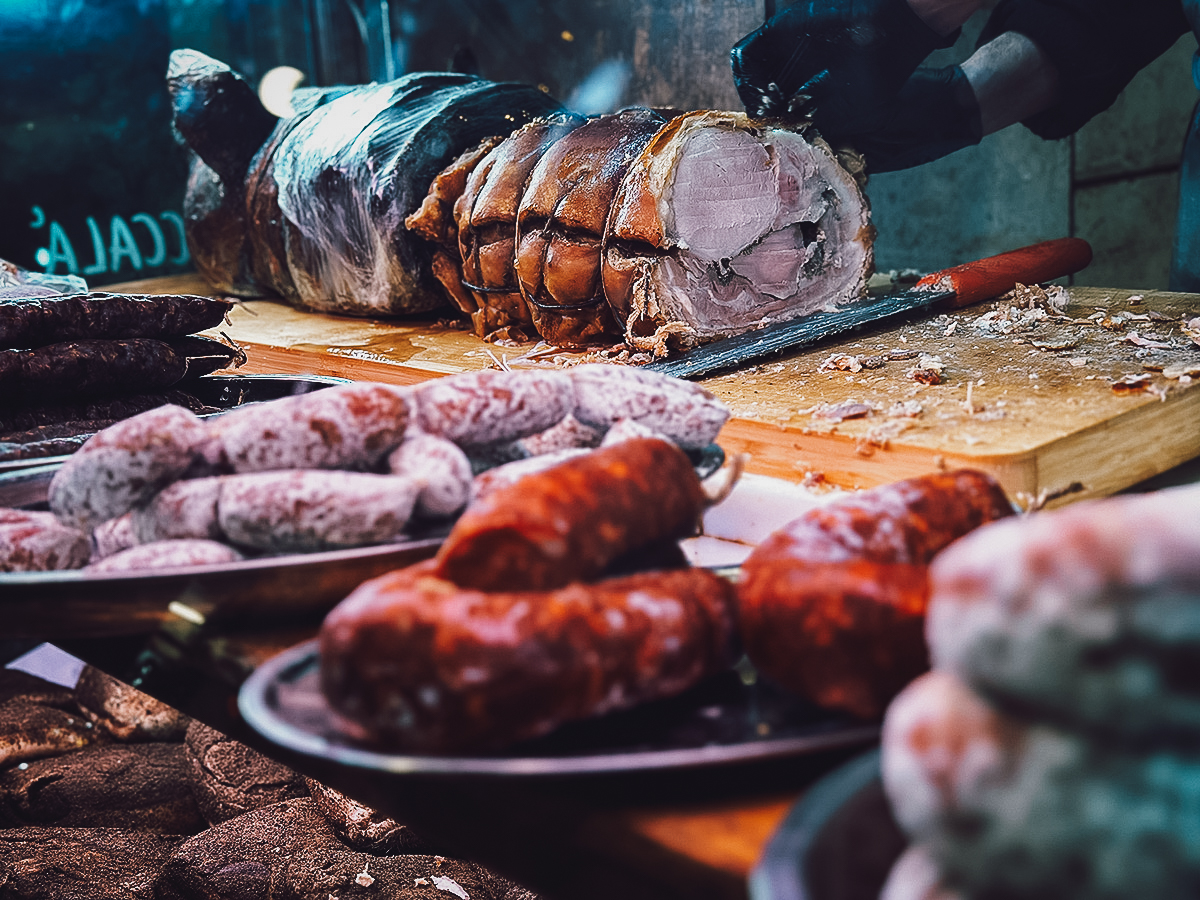

Porchetta is a popular street food in Rome, where it’s commonly served in paninis (sandwiches) or as a filling for pizza bianca (literally “white pizza”). Tonight, it was served to us as a topping on ciabatta.
I don’t eat meat anymore, but according to my better half, it was some of the best porchetta she’s ever had in her life. And it wasn’t even freshly roasted. Imagine how good this must be when served straight from the pit.


I’m on (mostly) a plant-based diet, so instead of the porchetta, Eating Europe was kind enough to serve me this plate of eggplant, olives, sun-dried tomatoes, and ciabatta topped with pesto.
According to the tour’s webpage, they can accommodate vegetarian diets, but vegan, kosher, and gluten-free options may be limited.


Aside from the porchetta, we were also given two types of iconic Italian cheeses to sample – Parmigiano Reggiano and Pecorino Romano. Like many people, we’ve had lesser versions of these cheeses before, but having them here in Italy made us feel like we were tasting them for the very first time. The difference is like night and day, especially with the Parmigiano Reggiano.
Parmigiano Reggiano is arguably the most famous cheese from Italy. A hard cheese made from cow’s milk, it’s governed by strict PDO regulations, meaning it needs to be wholly produced, matured, and packaged within a specific region of northern Italy to carry the Parmigiano Reggiano label. That grated stuff you’ve been eating from a green bottle? Sawdust compared to the real thing.
Like Parmigiano Reggiano, Pecorino Romano enjoys PDO status and must be produced within Lazio, Grosseto, or Sardinia to carry the Pecorino Romano label. Made from sheep’s milk, it’s a hard, salty cheese that’s often used for grating over pasta and other dishes.
Pecorino Romano is tasty, but my god, real Parmigiano Reggiano is something else.


And of course, a glass of wine to wash all that cheese and porchetta down. This glass of red, labeled “Ciu Ciu San Carro“, was produced by the Ciu Ciu Winery, an organic and vegan winery from the Marche region of central Italy.


GETTING MESSY AND LEARNING TO MAKE TWO TYPES OF PASTA
With ingredients in hand, we moved to a restaurant in Trastevere for the actual cooking class. We made our way to the back of the restaurant, where a large table with cutting boards, metal bowls, rolling pins, and Eating Europe aprons was neatly set up and waiting for us. Time to get messy!
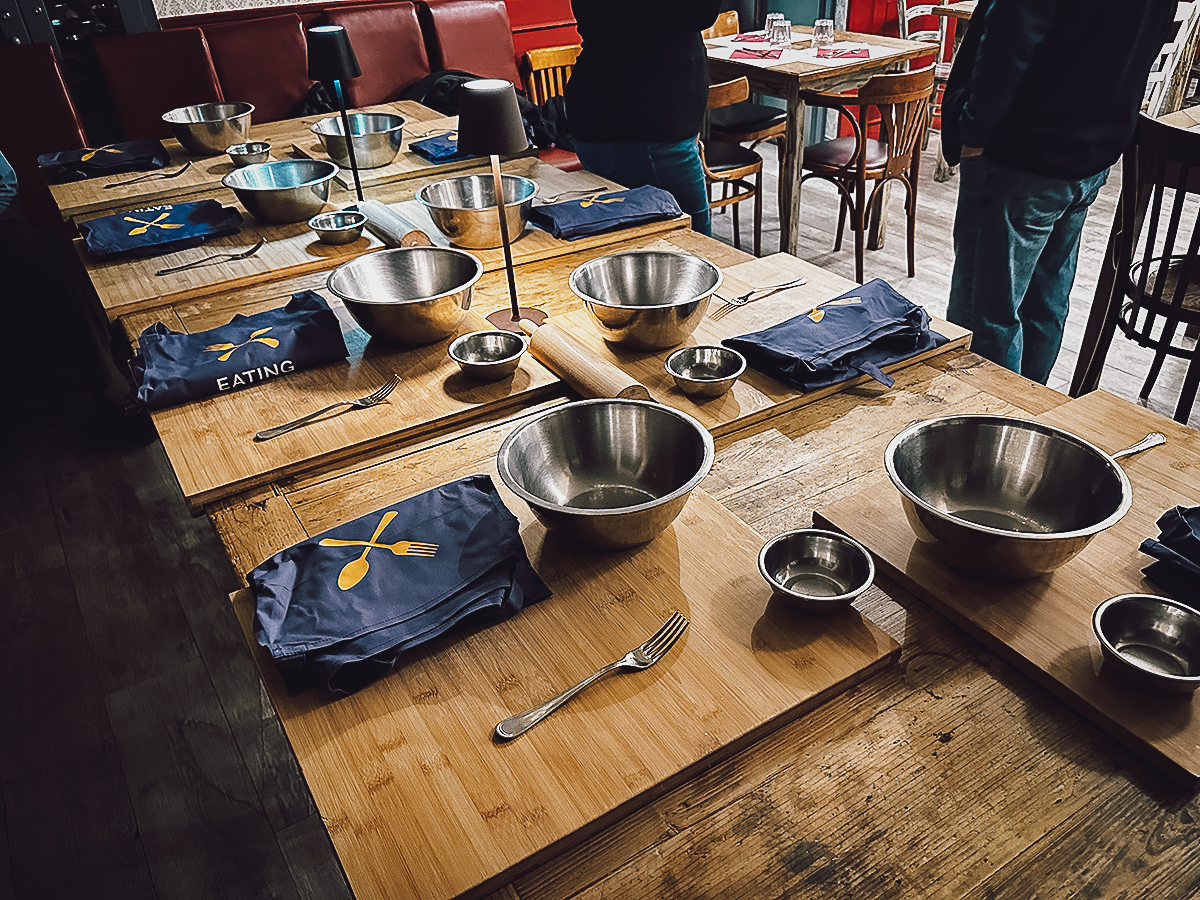
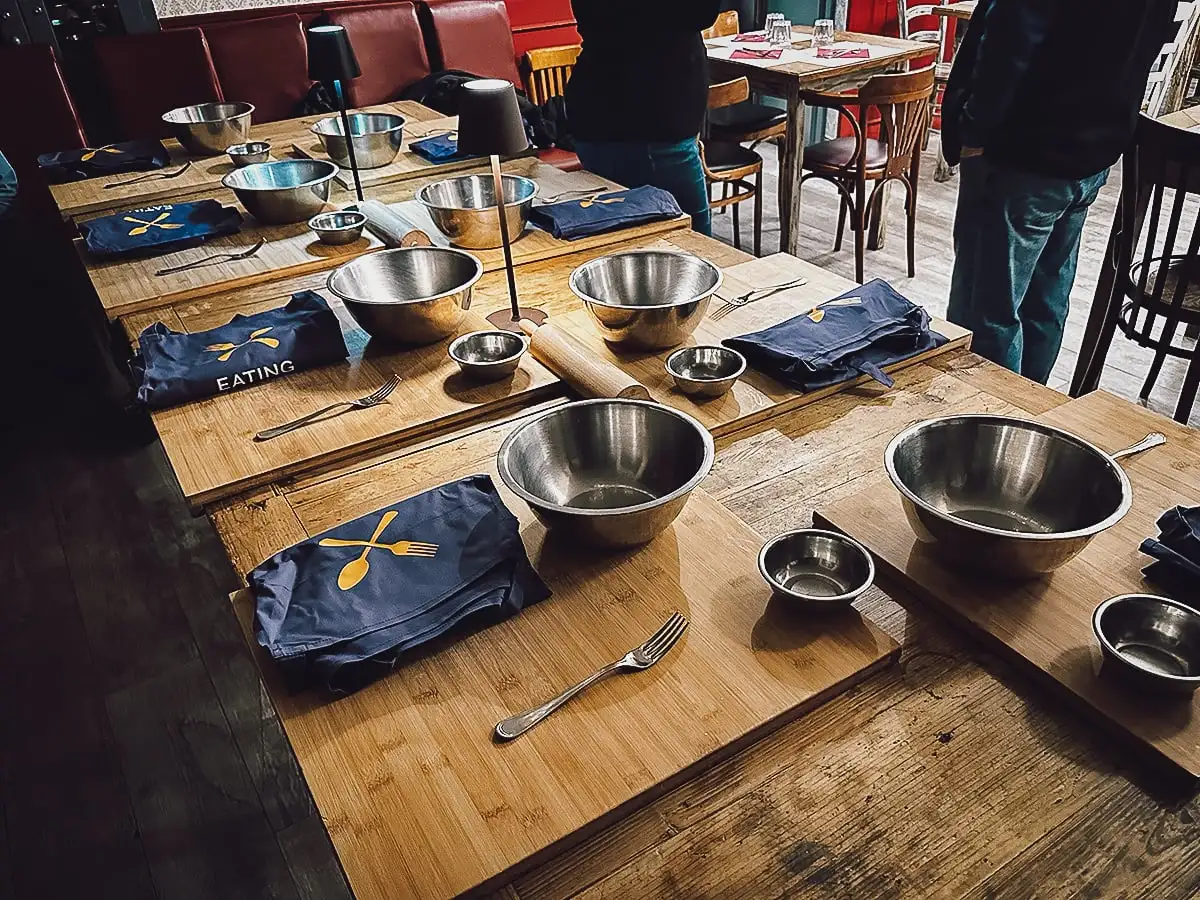
Mrs Traveleater rocking the Eating Europe apron and ready to make some pasta! We got to keep our aprons as souvenirs, which was nice.


During the class, Davide shared heartwarming stories about his beloved Italian grandmother. She taught him how to make pasta at the age of seven, and in turn, he taught his own son how to make it, also at seven.
He did a great job of explaining the basics to us before doing a demo. We would make two types of pasta tonight – fettuccine and ravioli stuffed with lemon ricotta.


Davide told us a hilarious story about his grandmother. He once asked her for the recipe for one of her signature dishes (I can’t remember exactly which one), which she happily shared with him. He followed the recipe to a tee and made the dish. It tasted good, but something about it was slightly off. Maybe he just didn’t have his grandmother’s touch.
He would later lose the recipe, so he asked his grandmother for it again. He later found the piece of paper where he had jotted it down the first time, only to discover that the recipe between versions was completely different. Ha! Well played Grandma.
I guess it’s true. Italian grandmothers really will take their closely guarded recipes to the grave.

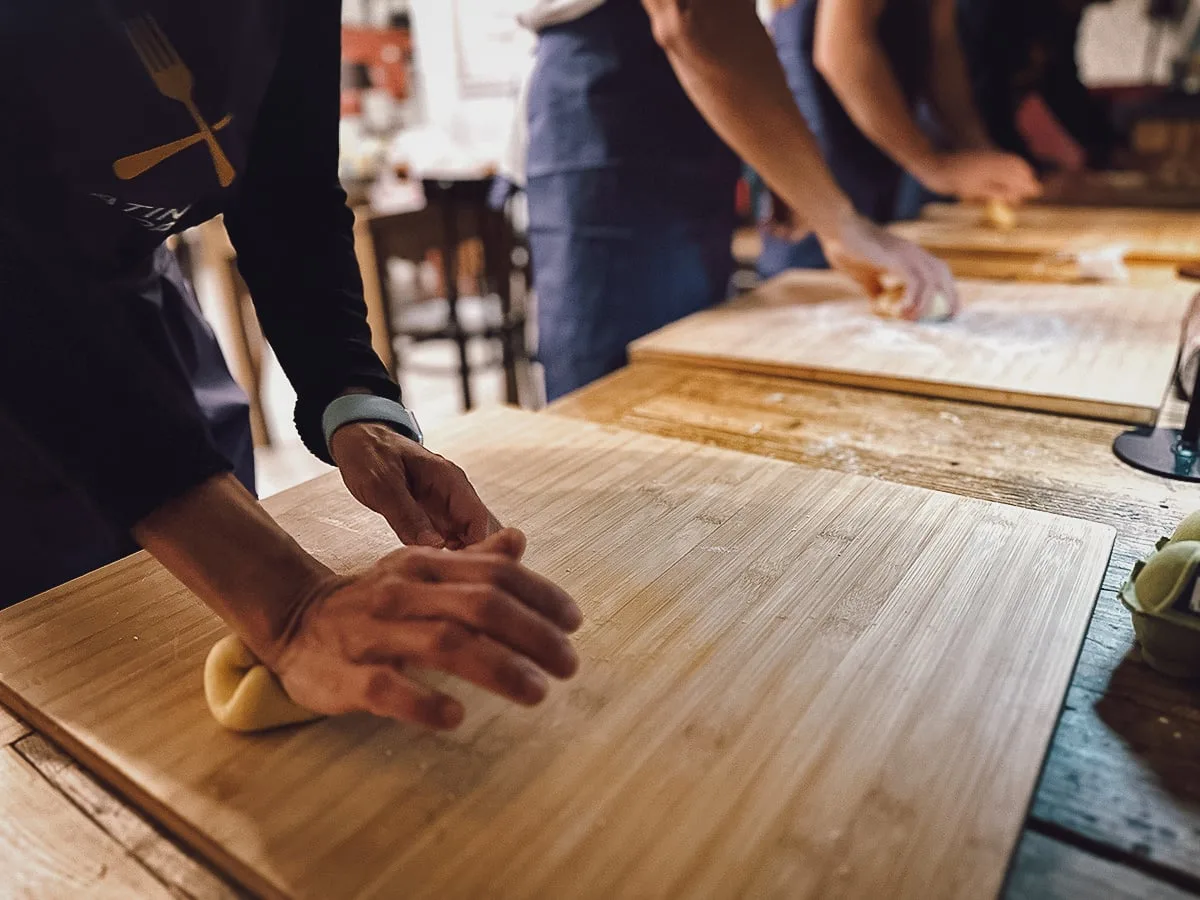
After we each made our balls of pasta dough, we let them rest in a covered bowl so Davide could show us how to make the filling for the ravioli. If I remember correctly, it was just ricotta, lemon zest, garlic, shaved white truffles, and 24k gold leaf.
See what I did there, Grandma? {winks}
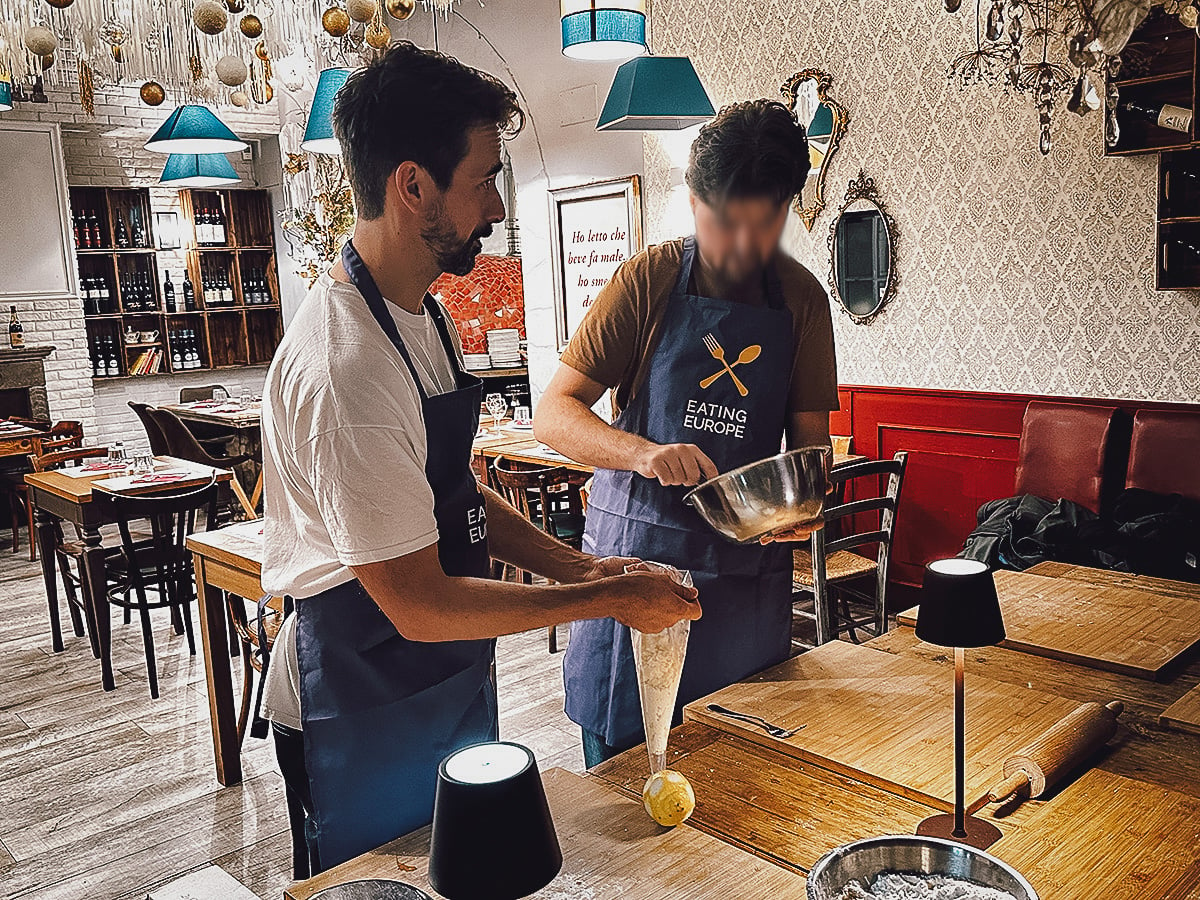

When our balls of dough were rested and ready, we flattened them using a pasta machine. This was fun! The goal was to get the sheet a little thinner than how you wanted the fettuccine to be when cooked.


This was my favorite part. When the dough was flattened to the desired thickness, we laid them out over these devices I had never seen before. Called a “guitar”, we pressed over the dough with a rolling pin to cut it into perfectly even strands of fettuccine pasta. Cool!
By the way, do you see the wine glass in the upper part of this picture? As the Eating Europe website advertised, we were allowed to drink as much wine as we wanted during the class. Also cool!


Around a third of the pasta dough was reserved for the ravioli. Davide showed us how to fill them, fold them over, and then (not so) expertly cut them into perfect squares of stuffed ravioli.
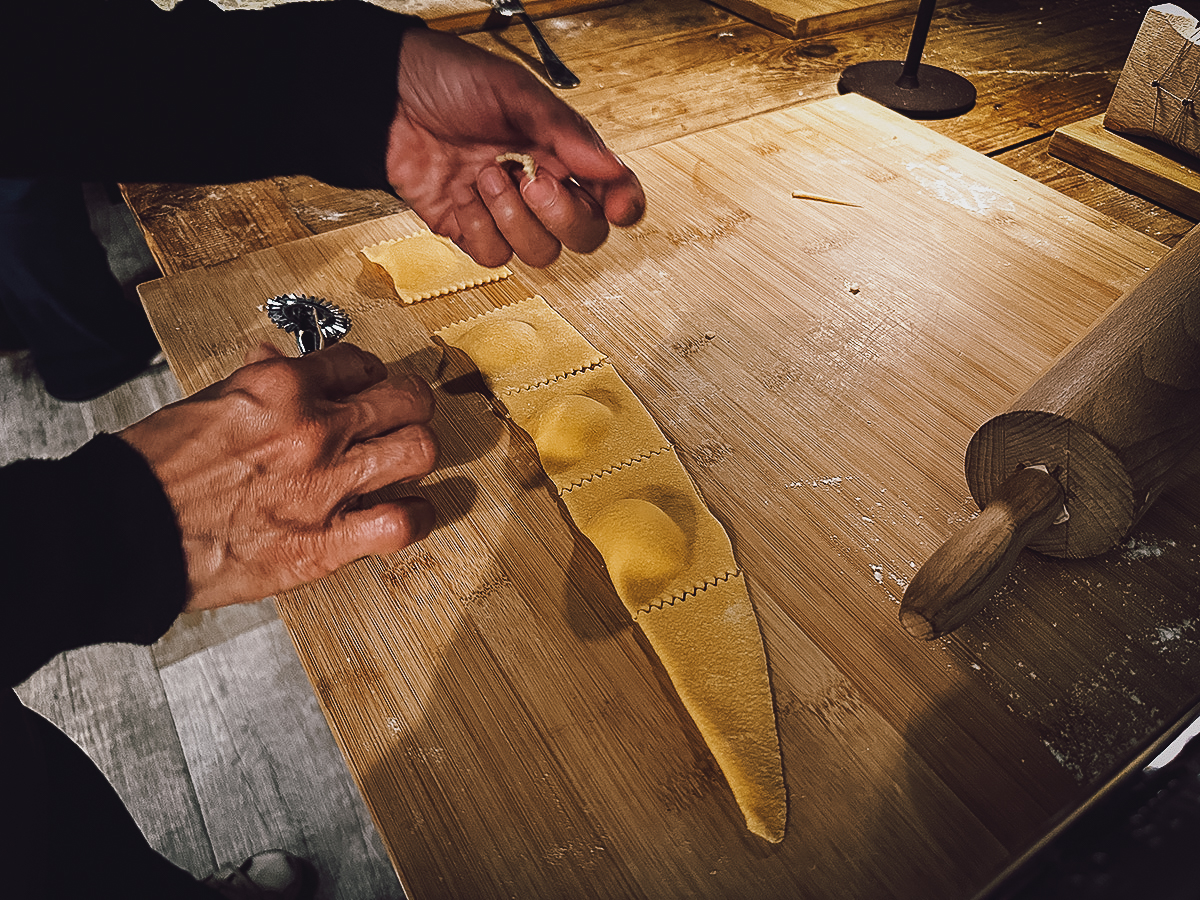

And voila! Our parcels of stuffed lemon ricotta ravioli, all laid out together and ready for boiling. Some were square, others were more like crooked rectangles, but all were perfect and proudly made by us.


An impressive mound of freshly made fettuccine. Isn’t it beautiful?
Our work here was done. The ravioli and fettuccine would be sent to the restaurant’s kitchen to cook.


After a few minutes, the pasta we all made would collectively come back to us, cooked in sauces prepared by the restaurant’s chefs. The fettuccine was served in an amatriciana sauce, while the stuffed ravioli was made with some type of cream sauce.


Since amatriciana sauce is made with guanciale (pork jowl), they served me my own portion of fettuccine cooked with a simple, vegetarian-friendly pomodoro sauce. Grazie mille!


Like family, we sat down to dinner with our new friends and enjoyed the fruits of our labor. Everyone but us was from the US, but it didn’t take long for us to connect on common ground. I was surprised to learn that one of the younger members of the group was currently attending the same university I graduated from in Washington, DC, almost thirty years ago!
Another round of thanks to Davide for doing such a great job leading the class. Not only did we learn a lot, but he did a wonderful job of putting us all at ease and making everyone feel included. The class was fun to begin with, but that made the experience truly special.
We took this cooking class on our very last day in Europe, and it could not have been a more fitting end to a fabulous and oh-so-delicious time in Rome and Italy. Thank you Davide and Eating Europe!


SAYING ARRIVEDERCI WITH GELATO
Before saying goodbye, Davide took us to one last stop – a popular gelato shop to show us what real gelato looks and tastes like. This was interesting.
According to him, one easy way to spot fake gelato is the color. Fake pistachio for example, is a bright green color, but real pistachio gelato will be much more muted in tone.
Another giveaway is the amount. Fake gelato shops will have overflowing mounds of gelato filling their vitrines. A real gelato shop will never do that. They make each flavor in small batches because real ice cream, made without any extenders, will melt.
The color I knew about, but the bit about the amount was news to me. We must have been fooled dozens of times in the past, but now we know!


Notice the amount of each flavor – they make them only in small batches at a time.
This shop had really interesting flavors, many of which I had never seen before. They use uncommon ingredients like Hokkaido pumpkin, persimmon, myrtle, ginseng, ginger, and horseradish, often in off-the-wall combinations! Really impressive considering they make every flavor from scratch.
Before choosing our flavors, Davide advised that the servers will ask if we wanted our gelato topped with whipped cream. According to him, just say yes.


We were allowed two flavors each. For her first flavor, Mrs Traveleater went with ricotta cheese and Greek-style figs. Forher second, she chose coffee rum Genoise cake with Amaretti biscuits. She decided to rebel and say no to the whipped cream topping. Ha!

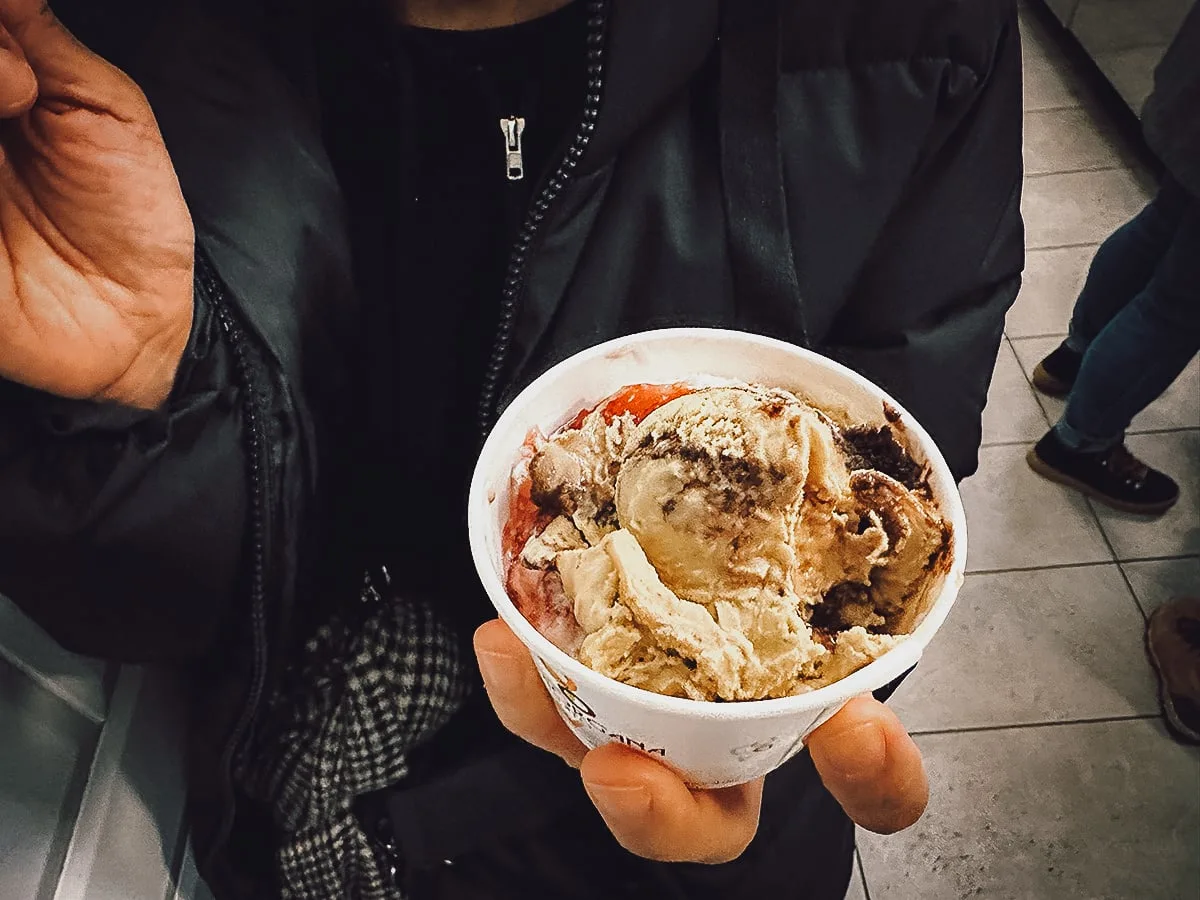
Judging from her immediate reaction, it’s safe to say she enjoyed both flavors tremendously. Imagine if she had gotten it with whipped cream?


FINAL THOUGHTS ON THIS COOKING CLASS IN ROME
To say that we enjoyed this pasta-making class would be an understatement. We loved it, and for many reasons.
One, the class was small, just seven people, so it felt like an intimate group of friends. It made it easy to follow Davide’s instructions, which, thanks to the small group size, he was able to communicate clearly and in a fun and engaging way. Everyone, even the quieter personalities in the group, felt included.
Two, it’s a pasta-making class, but it isn’t just a pasta-making class. The stops at the neighborhood meat shop and artisanal gelateria made it even more interesting. It’s nice to see a family-run business like that meat shop get some much deserved shine.
And three, it was held in Trastevere, which is one of the most interesting and charming neighborhoods in Rome. Some first-time visitors may not know about it, but taking this class introduces them to the area and gives them the opportunity to explore it.
Being one of the biggest food-focused tour operators in Italy and in Europe, Eating Europe clearly knows what it’s doing, and its perfect 5-star rating on Google Maps – with over 17,000 reviews – speaks for itself.
If this pasta-making class appeals to you, then you can book it on Eating Europe before your next trip to Rome.
Disclosure
This article on pasta making in Rome was written in collaboration with Eating Europe. They gave us a complimentary tour in exchange for an honest account of the experience. As always, all words, opinions, and thoughts expressed in this article are mine and mine alone.
Some of the links in this article are affiliate links, meaning we’ll earn a small commission if you make a booking at no additional cost to you. We really appreciate your support, as it helps us make more of these free travel and food guides. Grazie mille!